Feb 22, 2026
S01E07: Your Buyer Doesn't Have a Buying Process. Build Them One.
Speak fuller prompts. Get better answers.
Stop losing nuance when you type prompts. Wispr Flow captures your spoken reasoning, removes filler, and formats it into a clear prompt that keeps examples, constraints, and tone intact. Drop that prompt into your AI tool and get fewer follow-up prompts and cleaner results. Works across your apps on Mac, Windows, and iPhone. Try Wispr Flow for AI to upgrade your inputs and save time.
Your Deals Don't Have a Closing Problem. They Have a Clarity Problem.
Ask a rep why their deal stalled and you'll hear one of three things.
"They went dark."
"They're still evaluating."
"They need to align internally."
All three sound different. They're the same problem.
The buyer doesn't know what to do next.
Not because they're confused about your product. Because they're confused about their own process. They don't know who needs to approve what. They don't know the order of operations. They don't know what "yes" actually looks like inside their own company.
And if they don't know, you definitely don't know.
So the deal sits there. Waiting for someone to figure it out. Nobody does. And three weeks later you're writing a breakup email.
Last week I introduced the Deal Risk Scanner. Four dimensions that predict whether a deal will stall. Today I'm going deep on the one that kills more deals than the other three combined.
Process Clarity.
What Process Clarity actually means
Process Clarity isn't "do you have next steps scheduled."
That's activity. Activity and clarity aren't the same thing.
Process Clarity means: does the buyer know every step between today and a signed deal? Can they name the steps? Can they name the people involved in each step? Can they give you a rough timeline?
Most can't.
And here's the thing nobody talks about. That's not their fault. Most mid-market companies don't buy software every month. Your buyer might not have purchased a tool like yours in two or three years. They don't remember how it works internally. Or the process has changed since last time. Or there's a new CFO who added an approval layer nobody knew about.
They're not being evasive when they say "let me figure out next steps." They genuinely don't know.
Your job is to help them figure it out. Not wait for them to figure it out on their own.
The three signals your deal has a clarity problem
You don't need the Deal Risk Scanner to spot this. (Though it helps.) Look for these three patterns.
Signal 1: Vague time language
"We'll circle back after the holidays."
"Give us a couple weeks."
"We need some time to digest."
None of these are commitments. They're polite exits from the conversation. The buyer isn't saying no. They're saying "I don't know what happens next and I'm not going to admit that."
Signal 2: No named next approver
Your champion says "I need to run this up the chain." You ask who's in the chain. They pause.
If your champion can't name the next person who needs to weigh in, the process isn't unclear. It doesn't exist yet. You're hoping someone inside the account will build one. That rarely happens without your help.
Signal 3: You're the only one with a timeline
You have the deal in your forecast for this quarter. You've mapped out a mutual action plan. You sent it over.
But the buyer never confirmed it. Or they said "looks good" without engaging on the details. Your timeline is your timeline. Their timeline is "whenever."
That gap is where deals go to die.
How to fix it: the Process Clarity framework
The fix isn't "send a mutual action plan." That's a document. Documents don't create clarity. Conversations do.
Here's the three-step framework I use.
Step 1: Map their process with them (not for them)
Most reps build mutual action plans and send them over. That's backwards. You're telling the buyer how their company makes decisions. You don't know that. They do.
Instead, ask this question on your next call:
"If you decided tomorrow that this was the right move, what would need to happen inside your company before we could start? Walk me through it step by step."
Then shut up and write down every step they mention.
If they get stuck, help them with prompts like:
"Who signs off on the budget?"
"Does legal need to review?"
"Is there a procurement or vendor approval process?"
"Has anything changed since the last time your company bought something like this?"
You're not interrogating them. You're helping them think through their own process. Most buyers appreciate this. Because they haven't thought through it either, and you just saved them a week of internal confusion.
Step 2: Turn the conversation into a decision roadmap
Now you take what they told you and turn it into something they can use internally. Not a 15-row spreadsheet. A simple one-page roadmap that answers three questions:
What needs to happen? Who owns each step? By when?
This is where AI earns its keep. Here's the prompt.
I just had a conversation with a buyer about their internal decision process. Here are my notes on what they described:
[PASTE YOUR NOTES]
Create a one-page Decision Roadmap with:
1. Each step they mentioned, in order
2. Who owns that step (use names if I captured them, otherwise use role titles)
3. A realistic timeline for each step based on what they described
4. Any steps that seem missing (common ones they didn't mention, like legal review, security review, procurement, reference checks)
5. One "risk flag" for any step where the owner is unclear or the timeline is vague
Format it as a clean table I can paste into an email. Keep it simple. No jargon. This needs to make sense to someone inside the buyer's company who wasn't on our call.
At the bottom, add a short note I can include in my email like: "Here's what I heard. Did I get this right? Anything missing?"
The output is a roadmap your champion can forward to their boss, their procurement team, their legal team. It does three things at once:
It confirms you listened. It makes your champion look organized. And it surfaces missing steps before they become surprise blockers three weeks from now.
Step 3: Pressure-test the gaps
The roadmap will have holes. Steps with no owner. Timelines that say "TBD." Steps you suspect are missing but the buyer didn't mention.
Don't ignore these. Each gap is a future stall.
Here's the prompt to figure out what to do about them.
Here is a Decision Roadmap for a deal I'm working. Some steps have unclear owners or vague timelines:
[PASTE THE ROADMAP]
For each gap or risk flag:
1. Explain why this gap is dangerous (what happens if it's not resolved)
2. Give me one specific question I can ask my champion to close the gap
3. If the champion probably can't answer, suggest who inside the account I should ask to be introduced to
Keep the questions conversational. I don't want to sound like I'm running an audit. I want to sound like I'm trying to help them stay on track.
Now you have questions ready for your next conversation. Specific ones. Not "how's the process going?" but "Sarah, you mentioned legal needs to review. Have you looped them in yet, or should we send something over to get that started?"
That's the difference between hoping and managing.
What this looks like end to end
Here's a quick example so you can see the full flow.
Your notes from the call
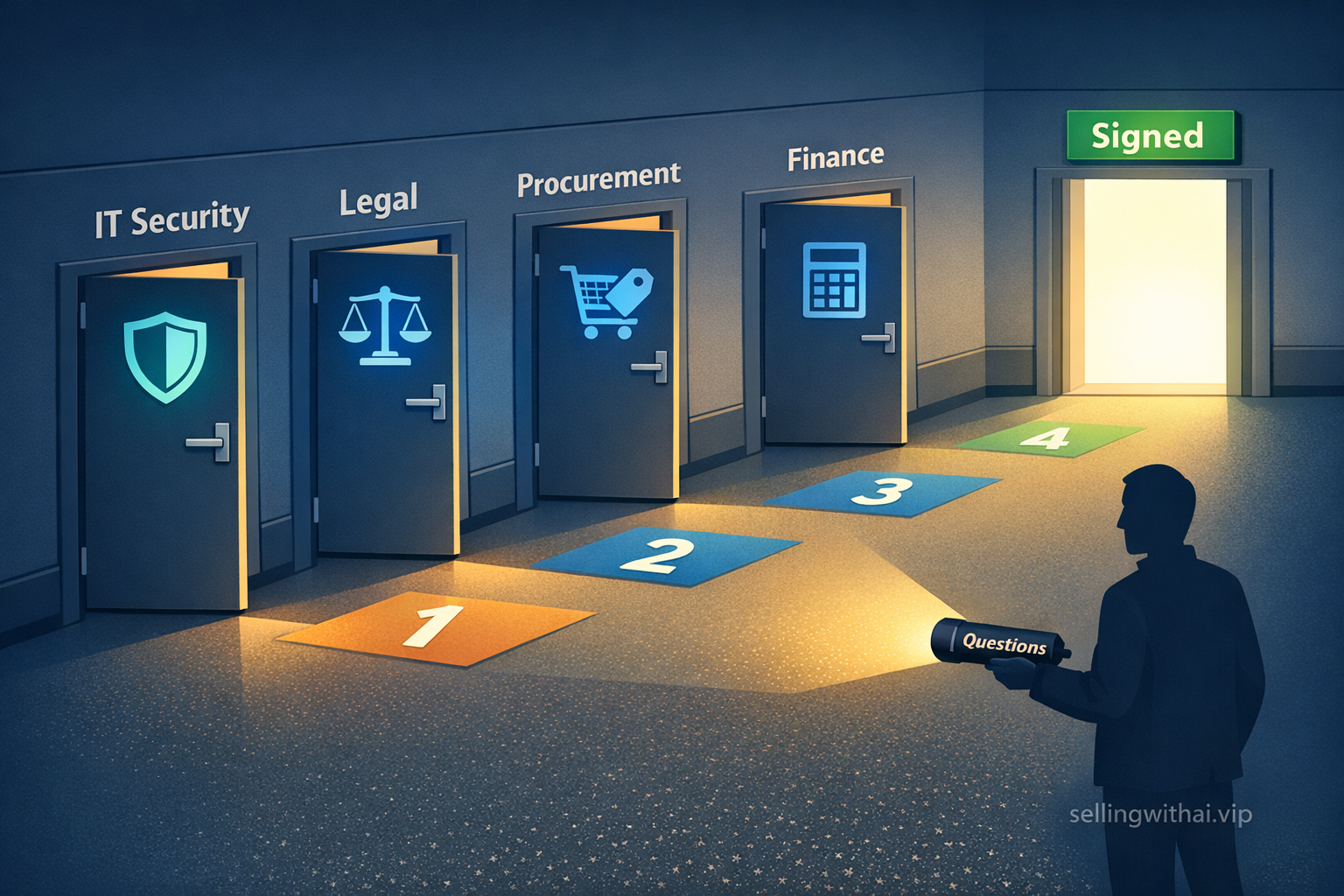
Champion (Lisa, Director of Talent Ops) said they want to move forward but "need to get a few people on board." When I asked who, she mentioned her VP (Rachel), the IT team for a security review, and "probably procurement." She wasn't sure if procurement had a formal process or not. She said Rachel is supportive but hasn't seen a demo yet. Lisa asked if we could "send over some materials" for Rachel to review. No timeline discussed beyond "before end of quarter."
Decision Roadmap (AI output, cleaned up)
Step | Owner | Timeline | Status |
VP demo or review | Lisa to schedule with Rachel | This week | Not started |
IT security review | IT team (name unknown) | ~1 week after VP approval | No owner named |
Procurement review | Unknown | Unknown | Process unclear |
Contract/legal review | Not mentioned | Unknown | Possibly missing |
Final sign-off | Rachel (VP) | Before end of quarter | Vague |
Look at that roadmap. Three red flags. One yellow. And the only step with a clear owner and action is the first one.
Without this, you send "materials" to Lisa and wait. With this, you send Lisa the roadmap and say:
"Lisa, here's what I captured from our conversation. A couple of things I want to flag: I don't think we've identified who handles the security review, and I'm not sure if procurement will add time. Can we figure these out now so nothing surprises us later?"
You just prevented two stalls that would have hit you in week three.
Why this is the highest-leverage thing you can fix
Every dimension in the Deal Risk Scanner matters. But Process Clarity is different.
Buyer Confidence is about their belief. You can influence it, but you can't control it.
Internal Alignment depends on people you may never meet.
Decision Ownership depends on your champion's willingness to step up.
Process Clarity is the one dimension you can directly improve. Right now. On every deal. By asking better questions and building the roadmap your buyer won't build themselves.
Fix this one thing and you'll notice something. The other three dimensions start improving too. When the process is clear, buyers feel more confident. Stakeholders align faster because they know what's expected of them. And someone steps up to own the decision because the path is visible.
Clarity creates momentum. Confusion creates stalls.
Go deeper with the Deal Risk Scanner
What I showed you today is one dimension. The full Deal Risk Scanner scores all four after every interaction and tells you exactly where to focus.
It includes:
The complete scoring system across Buyer Confidence, Internal Alignment, Process Clarity, and Decision Ownership. Run it after any call, email, or meeting.
Deep-dive prompts for each dimension. The Process Clarity prompts I shared today are a taste. The full kit goes just as deep on the other three.
A follow-up email generator that writes decision-advancing emails based on your weakest score. Not recaps.
A pipeline review formatter so you walk into your next 1:1 with scores and gaps instead of gut feelings.
Available as a Custom GPT and a Claude Project. Use whichever you prefer.
Pull up your pipeline right now. Pick the deal that's been "in progress" the longest.
Ask yourself: can I name every step between today and a signed contract? Can the buyer?
If not, that's your next conversation. Don't wait for the silence. Build the roadmap now.
Talk next week.
The Prompts + the Deal Risk Scanner + the Process Clarity Toolkit

Translation missing: en.app.shared.conjuction.or Sign In